Trinity Engine is LansonAI's core engine for multi-model orchestration, speech processing, and context coordination. It is the shared processing foundation behind Lanson Live API and Lanson Live App.
It sits below product experiences and developer-facing APIs.
Conceptually:
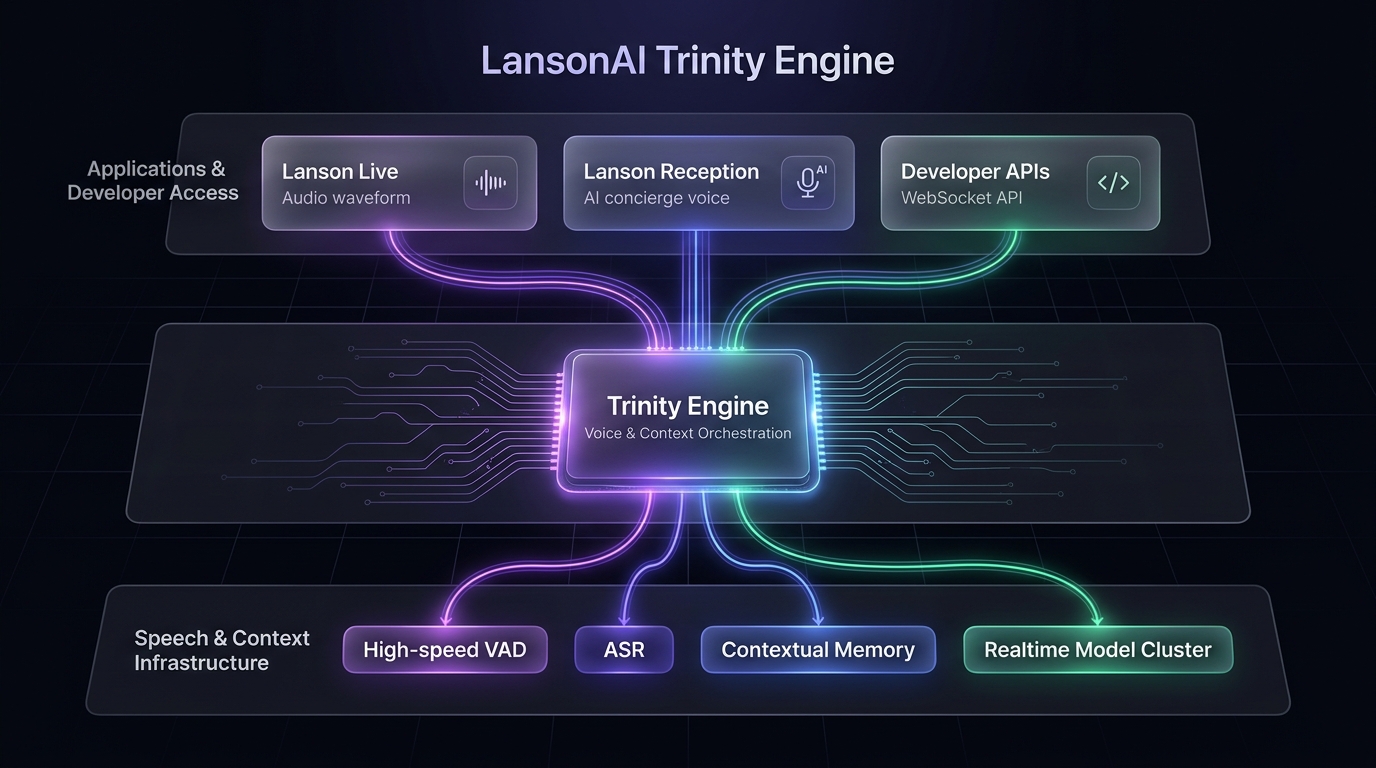
What Trinity Engine does
Trinity Engine coordinates the processing required to turn incoming speech into application-ready context.
This includes multiple stages that may operate at different timescales, such as:
- speech processing
- segmentation
- contextual interpretation
- correction
- stabilization
- multilingual processing
The exact internal implementation may evolve independently of the developer-facing API.
Why the separation matters
Applications should not need to understand the internal processing architecture in order to use LansonAI.
The developer contract exists at the API layer.
Trinity Engine exists below that contract.
This separation allows LansonAI to improve its internal speech and context processing while keeping application integrations stable.
Relationship to StableStream™ and LiveFinal™
Trinity Engine, StableStream™, and LiveFinal™ describe different layers. None is a customer-selectable model.
Trinity Engine The processing foundation.
StableStream™ The behavior and continuity of evolving context exposed to live applications.
LiveFinal™ The mechanism for progressive correction and segment finalization. See LiveFinal™ for the current public endpoint's delivery behavior.
This distinction is important because the developer experience should be defined by observable behavior rather than internal implementation details.
The App and API may expose different processing stages. Integrations must follow the API's documented events rather than assuming every App interaction is available over the public API.