LansonAI is the Voice Context Layer for Live Speech. A Voice Context Layer sits between live speech recognition and the application that consumes it. Developers access this capability through Lanson Live API.
Realtime, Segment, and Batch are three integration paths of Lanson Live API:
Its job is not simply to produce words.
Its job is to turn continuously changing speech into usable context.
Speech recognition is only the first layer
A speech recognition system may produce something like:
I think we should meet on
I think we should meet on Thursday
I think we should meet on Thursday afternoon
I think we should meet Thursday afternoon insteadEach output may be reasonable at the moment it was generated.
But an application has different questions:
- Which text should already be visible?
- Which text may still change?
- When is a thought complete enough to translate?
- When should downstream logic act on it?
- How should corrections appear without disrupting the reader?
Those questions exist above recognition itself.
That is the problem addressed by the Voice Context Layer.
From audio to usable context
Conceptually, a live speech system can be viewed as:
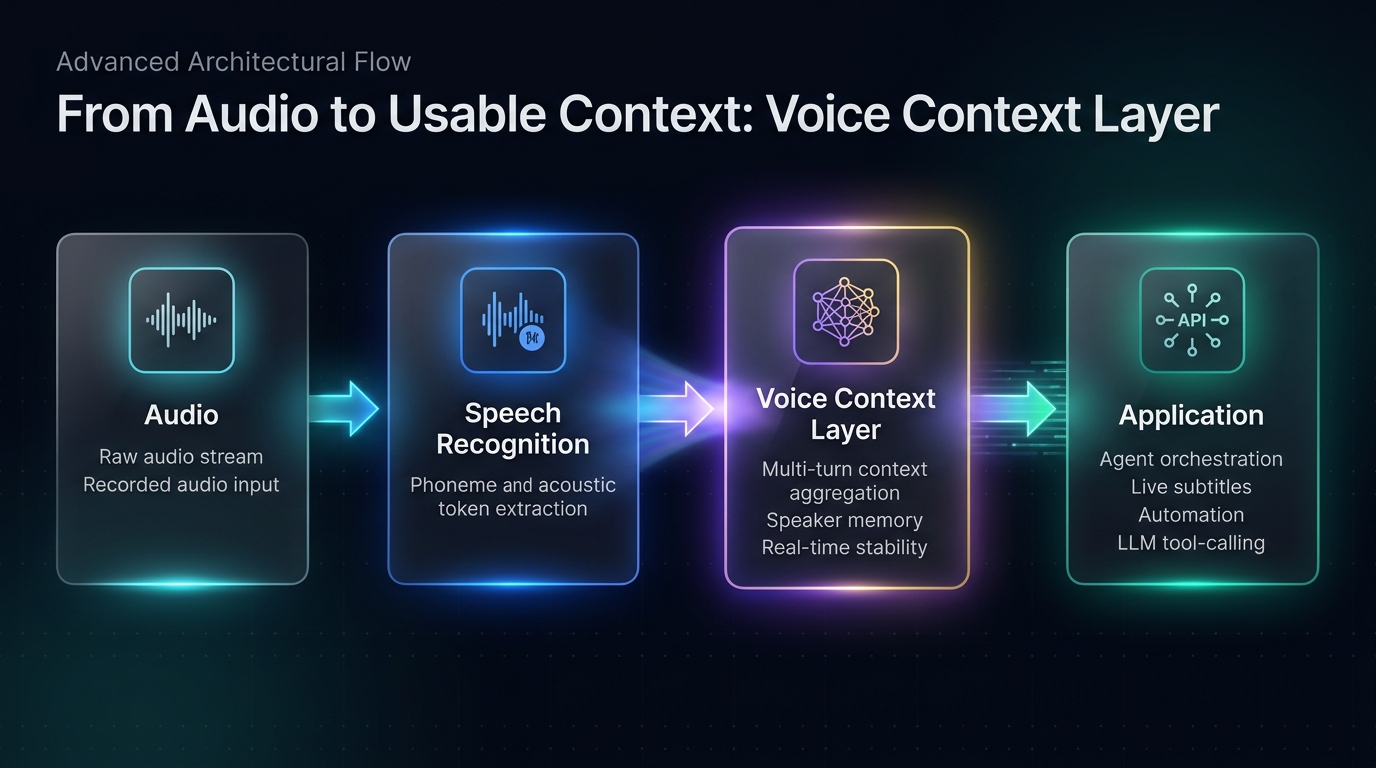
The recognition layer determines what was likely spoken.
The Voice Context Layer determines how that evolving information should become usable by the application.
This may include:
- stabilization
- contextual correction
- segmentation
- translation readiness
- presentation continuity
- lifecycle state
Why this matters
For offline transcription, the system can wait until the audio has finished before producing the final result.
Live applications cannot.
They must continuously balance two competing goals:
Responsiveness
Show useful information as soon as possible.
Stability
Avoid repeatedly changing information the user has already read.
LansonAI is designed around that tradeoff.
The objective is not simply to make text appear faster.
It is to make live speech ready to use while it is still happening.
Technology layers
- Trinity Engine — multi-model orchestration, speech processing, and context coordination.
- StableStream™ — continuous, stable, readable live text.
- LiveFinal™ — progressive correction and segment finalization.
These names explain how Lanson Live works. They are not three selectable models, and concept diagrams are not additional event schemas. The API reference defines the messages you can send and receive.
API and App
Lanson Live API is for developers building speech into their own applications. Lanson Live App is the end-user product for live speech experiences. They share Trinity Engine, but the App's behavior is not an API contract.
Lanson Flow, Lanson Live App, Lanson Reception, and Lanson Podcast are product lines for different speech use cases. The Developer panel in Lanson Live App lets you create and manage API keys. To start integrating, follow Get started with Lanson Live API.